
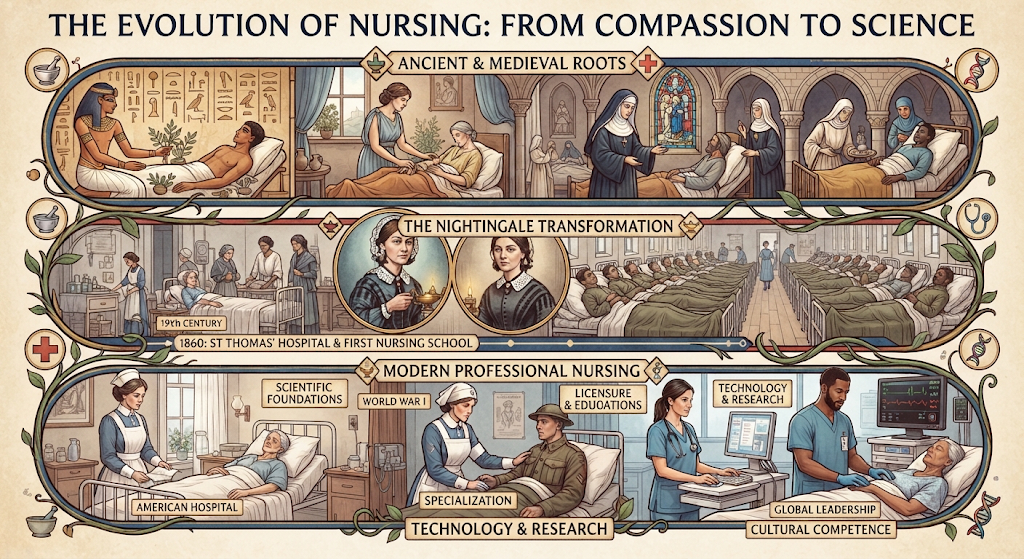
Nursing is one of humanity’s oldest caring practices: it began as family and community care for the sick, became organized through religious and hospital institutions, and evolved into a science-based, licensed profession led globally by figures such as Florence Nightingale. Today, nursing combines compassionate care with research, technology, public health, and advanced clinical practice.
Ancient beginnings
In ancient societies, care of sick and injured people was usually a family responsibility, often carried out by women in the home. Communities also relied on healers and herbalists with knowledge of medicinal plants, hygiene, wound care, childbirth, and holistic healing.
Ancient civilizations including Egypt, Greece, Rome, China, India, and Indigenous societies developed systems of healing and caregiving. In many cultures, religious beliefs shaped ideas about illness, healing, compassion, and service to the vulnerable.
Religious and medieval care
During the Middle Ages, much nursing in Europe was provided by monks and nuns in monasteries, convents, and early hospitals. Their work emphasized charity, prayer, shelter, basic medical care, and care for the poor during frequent epidemics.
Islamic civilization also developed major hospital institutions, known as bimaristans, which employed trained staff and helped establish more systematic approaches to patient care. These institutions influenced medical and nursing practice across the Islamic world and beyond.
In the Renaissance, growing knowledge of anatomy, physiology, and scientific methods began changing medicine. Nursing itself, however, remained largely informal and undervalued for centuries.
Birth of modern nursing
Modern professional nursing is traditionally dated to Florence Nightingale’s work during the Crimean War (1853–1856). In 1854, she led a team of nurses to British military hospitals, where overcrowding, poor sanitation, infection, and inadequate supplies caused enormous suffering.
Nightingale emphasized sanitation, ventilation, clean water, nutrition, organized records, and compassionate patient care. Her use of statistics to demonstrate that improved hygiene reduced deaths helped establish nursing as a discipline grounded in evidence as well as compassion.
In 1860, the world’s first formal nursing school opened at St Thomas’ Hospital in London, marking the beginning of structured nursing education and professional standards.
Nursing becomes a profession
The late 19th century saw nursing become organized, educated, and regulated. In the United States, the first major professional training programs began in 1873 at Bellevue Hospital in New York, the Connecticut Training School, and Massachusetts General Hospital in Boston.
Early hospital-based programs were often apprenticeship-like: students provided much of the bedside labor while receiving limited classroom instruction. Over time, licensing boards, professional associations, and state registration laws improved education and created the legal status of the registered nurse (RN).
Important developments included:
- The American Nurses Association was established in 1911.
- Public health nursing expanded through leaders such as Lillian Wald, whose Henry Street Settlement work in New York brought nursing services to poor communities.
- Nursing specialties emerged, including nurse anesthesia and nurse-midwifery.
- The profession remained racially segregated and largely excluded men for much of its early modern history; these inequities were only gradually challenged in the 20th century.
Wars and expansion
World War I created urgent demand for nurses, with about 23,000 American nurses serving in the military. Their work strengthened recognition of nursing as an essential profession and expanded roles in military and civilian health care.
World War II further increased nursing’s importance: about 78,000 American nurses served during the conflict. After the war, hospitals needed more nurses for increasingly complex care, but low pay, difficult conditions, and workforce shortages created major challenges.
Wars also accelerated advances in trauma care, infection control, anesthesia, rehabilitation, mental health care, and organized hospital systems.
Education and specialization
By the mid-20th century, nursing education moved away from hospital apprenticeship models toward colleges and universities. By 1960, about 172 college-based nursing programs in the United States awarded Bachelor of Science in Nursing degrees.
Community-college associate-degree programs also expanded, providing a faster and less expensive route into bedside nursing. At the same time, research increasingly showed that baccalaureate-prepared nurses were associated with better patient outcomes.
From the 1960s onward, nursing diversified into specialized fields such as intensive care, oncology, pediatrics, psychiatric care, community health, and critical care. Advanced practice roles, including nurse practitioners, clinical nurse specialists, nurse anesthetists, and nurse midwives, became established parts of modern health systems.
Nursing today
Modern nursing is both an art and a science. Nurses assess patients, develop care plans, administer treatments, coordinate with physicians and other professionals, educate families, advocate for patients, and promote health in hospitals, clinics, homes, schools, and communities.
Contemporary nursing is shaped by:
- Evidence-based practice, research, and quality improvement.
- Electronic health records, data-driven care, and digital documentation.
- Telehealth, remote monitoring, wearables, and mobile health applications.
- Greater emphasis on cultural competence, patient-centered care, ethics, and health equity.
- Advanced practice and leadership roles in primary care, policy, education, and research.
The COVID-19 pandemic highlighted nurses’ frontline role in intensive care, vaccination, infection prevention, public-health communication, and crisis response. It also intensified concerns about burnout, staffing shortages, and the need to protect nurses’ mental and physical well-being.
Major timeline
| Period | Key development |
|---|---|
| Ancient era | Family, community, religious, and herbal caregiving; early healing traditions. |
| Middle Ages | Monks, nuns, and religious orders provide much of European nursing care; Islamic hospitals develop organized care. |
| 1854–1856 | Florence Nightingale transforms military hospital care during the Crimean War. |
| 1860 | First formal nursing school opens at St Thomas’ Hospital, London. |
| 1873 | First major professional nursing schools begin in the United States. |
| Late 1800s | Nursing associations, licensing, registration, and public health nursing develop. |
| 1911 | American Nurses Association is established. |
| World Wars I and II | Nursing expands dramatically in military, hospital, anesthesia, and public-health settings. |
| 1950s–1960s | Nursing education shifts toward universities; specialties and advanced practice roles emerge. |
| Late 1900s | Evidence-based practice, nursing research, greater workforce diversity, and expanded professional autonomy grow. |
| 21st century | Telehealth, electronic records, global health crises, advanced practice, and ongoing workforce challenges define modern nursing. |
The central idea
The history of nursing is the history of people turning compassion into organized knowledge. What began as informal care within families and religious communities became a global profession defined by education, ethics, scientific evidence, patient advocacy, and leadership in health care.